
If it hurts a little, you made a decision – Blockers Episode 5
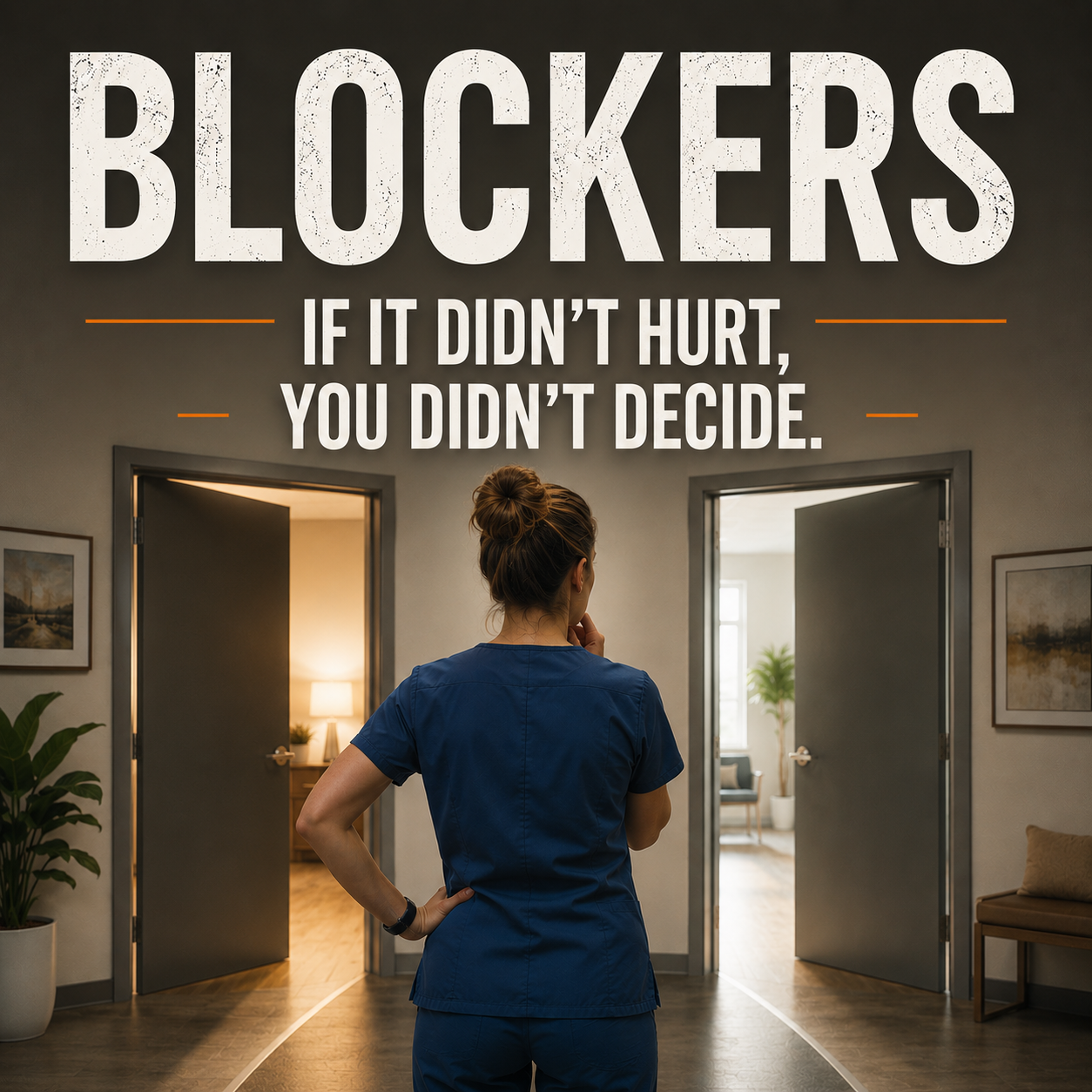
If it didn’t hurt, you didn’t decide.
BLOCKERS—A weekly series on removing obstacles to success in your practice–Episode 5.
A practice called recently to freeze their account subscription to BodySite.
Freezing is a real option we offer. You get to keep your account, keep everything you’ve built, patient education, notes, forms. You pay a small holding fee, and you don’t have access until you come back. We offer that because sometimes life happens and I’d rather someone pause their account than lose three years of work.
We asked why.
The provider said they hadn’t been able to get their care program into the platform.
So we offered to build it for them. That’s a service we sell and often do free, and in this case we offered it as a way to keep them going. We wanted to remove that blocker to their success.
And then they said the honest thing out loud that often they don’t say or acknowledge.
They’re still trying to create the program.
They don’t have a program or its content laid out yet. And they said they haven’t had the manpower to get it on paper in the first place— even to send to us to build it in the platform.
Read that again, because there are three separate blockers stacked in it, and only the last one is real.
Stated blocker: we couldn’t get our program into your software.
Blocker removed — we’ll do it for you — and the next one appears: we don’t have the content written.
Remove that blocker—let’s meet and we’ll write it down together— and you get to the floor:
THEY DON’T HAVE A PROGRAM
Not “there’s a program we haven’t documented.” There is no program. There’s an intention, a market they’d like to serve, and a real belief that something should exist. But nothing exists yet, and “we don’t have the manpower to get it on paper” is what that feels like from the inside.
Writing down a program you’ve already designed isn’t a manpower problem. It’s an afternoon. You could speak it into chatGPT and it would materialize in minutes.
Manpower is the excuse you use when the thing you’d be writing down doesn’t exist.
None of this is a knock on them. They were more honest with us than most people are with themselves. And they’re not unusual — I have been having this exact conversation for ten years.
But here’s the part I actually want to talk about.
The freeze was not a decision
It felt like one. It went on a to-do list and came off it. There was a call, a form, a confirmation email. Something got handled.
And nothing changed.
The program still doesn’t exist. The market still doesn’t know they exist. Six months from now they’ll be exactly where they are today with less momentum, and the freeze will have quietly become a cancellation, and nobody will be able to point at the moment it went wrong.
That’s a fake decision. It has the shape of a decision — the paperwork, the relief, the closure — and it changes nothing about the actual situation.
I want to give you a way to spot these fake decisions, because I think they’re the single most expensive thing in your practice and they’re almost invisible. And they are so easy to fix when you remove the blocker and take the small necessary action you’re afraid of.
The test to see if it was a decision
A real decision costs you something today.
Did it hurt a little bit? Did it make you feel a little queasy? That’s it. That’s the whole test.
If you decide to run a 30-day metabolic program starting in October and you put it on the calendar and promise it to someone, that decision costs you something today — you have to figure out what’s in it, what it costs, who it’s for. Uncomfortable, immediately.
If you decide you’re going to “explore options for a patient education solution,” that costs you nothing today. It costs you October.
Real decisions create work. Fake decisions create relief.
If you tell someone you have something in mind, and they say, “Oh, that’s a great idea,” you didn’t make a decision. If you tell them you’ve decided to launch a program or campaign on October 6, and they say, “Wow, how will you get that done?” “Can you afford that?” Etc., you’ve made a decision.
The relief is the tell
Here’s the part that took me years to see in building my own businesses.
When you make a genuinely hard decision, you don’t feel great afterward because you just closed off options and committed to something that might not work.
When you make a fake decision, you feel relief.
That relief is the payoff you were actually shopping for. You weren’t thinking about the outcome you really needed — just the feeling of having dealt with it, for now.
So the tell is simple: after you decide something, notice how you feel. If the dominant feeling is relief, go back and check whether anything actually changed. Most of the time you’ll find that you deferred the decision and gave the deferral a name.
You already have a list of these
You do. Everyone does.
Here’s what they look like in a practice:
Freezing something instead of using it or ending it. A subscription, a project, a hire you’re not sure about.
Scheduling a meeting to discuss the thing instead of doing the thing. The meeting is real. The calendar entry is real. Nothing was decided.
Buying the tool. The purchase produces a receipt, a login, and a genuine feeling of progress. Ask any practice with four platforms they don’t use.
“We’re evaluating options.” The most respectable one on the list. It can run for eighteen months and nobody will ever question it, because evaluating is what serious people do.
Hiring someone to tell you what you already know. Sometimes right. Often a very expensive way to postpone a decision you’ve already made and don’t want to own.
Deciding to focus on quality this quarter. Unfalsifiable, so it can never fail, so it never has to be revisited.
Every one of those feels like management. Every one of them produces relief. None of them costs anything today.
The people around you already know
Here’s the uncomfortable part.
Your spouse knows. Your office manager knows. Your friend from residency who you have dinner with twice a year knows.
They talk about it, gently, when you’re not in the room. Why doesn’t she just do that thing we keep talking about?
They’re not being unkind. They just have the outside view, and from the outside a fake decision is obvious. It’s only invisible from inside, where the relief is.
If you want to shortcut this whole article: ask one of them. They’ll tell you in about four seconds, and they’ll be right, and some part of you already knows exactly what they’re going to say.
You know this. You watch it every week.
A patient books an appointment for something they’ve been putting off for a year.
The moment they book, they feel better. Genuinely better. The dread lifts. They tell their spouse they’re finally dealing with it.
Nothing has been dealt with. They just moved the dread onto a calendar. It’s a good first step.
Then some of them cancel. And rebook. And cancel. And the whole time, they experience themselves as someone who is working on their health — because each booking delivers another small dose of relief.
Or the more familiar one: the patient who buys every supplement you recommend and takes none of them. The purchase was the event. The bottle on the counter is a receipt. And they will tell you, sincerely, that your protocol didn’t work.
You have never once believed those patients had a knowledge problem. You know exactly what happened — they bought the feeling instead of doing the thing.
Then you walk into your own business and freeze the account for the software you need. Or you don’t buy the thing you know you need to expand. Maybe next month.
What to do today
Look at the last three things you “decided.” Not big strategy — the ordinary ones from the last month.
For each, ask what it cost you that day. Not what it will cost. What changed within twenty-four hours.
If the answer is nothing, it wasn’t a decision. It was a deferral wearing a decision’s clothes. That’s fine — you can go make the real one now.
Then make one real decision this week. One. Something that costs you something today: a price you commit to, a program you’ll run in October with a hard date, whether or not it’s perfect, a conversation you’ve been circling for a month.
It’s almost certainly the thing you don’t want to do. That’s not a coincidence — that’s the identifying feature.
Expect to feel worse, not better. That’s how you’ll know.
And where I come in
I’m going to say something against my own interest here, and I’d rather say it than not.
The freeze option is good for me. It keeps an account on my books, it keeps a relationship alive, and it turns a cancellation into a smaller number that still shows up in my revenue.
For a lot of the people who take it, it’s the wrong call.
Not because they should have cancelled — because they should have made a real decision instead. Either “we’re going to launch something in the next sixty days and here’s what it is,” or “this isn’t the year, we’re out, and we’ll come back when it is.” Both of those are decisions. Both cost something the day you make them.
The freeze is the option that costs nothing today. Which is exactly why it’s the one people reach for.
So if you’re sitting on a frozen account somewhere — mine or anyone else’s — that’s worth ten minutes of your attention this week. Not because I want your subscription back. Because the frozen thing is usually a decision you’ve been avoiding, sitting in a drawer, quietly accruing.
And if what you actually need is help figuring out what the program should even be, or what else you need to do, that’s a conversation, not a project, and I’ll have it with you for free. That’s the part nobody can do for you, and it’s also the part that takes twenty minutes with the right questions.
Just don’t freeze it again.
Email me and say frozen, and I’ll tell you what I think the real decision is.
John Cummings
Founder, BodySite.com
P.S. — If you’re not sure whether something was a real decision, ask the person who’d have to do the work. They always know.
Catch up on the series: Episode 1 — Stop looking at the car · Episode 2 — What should I do first? · Episode 3 — Just start with breakfast · Episode 4 — Your patient forgot everything in the parking lot