
Your patient already forgot – Blockers Episode 4
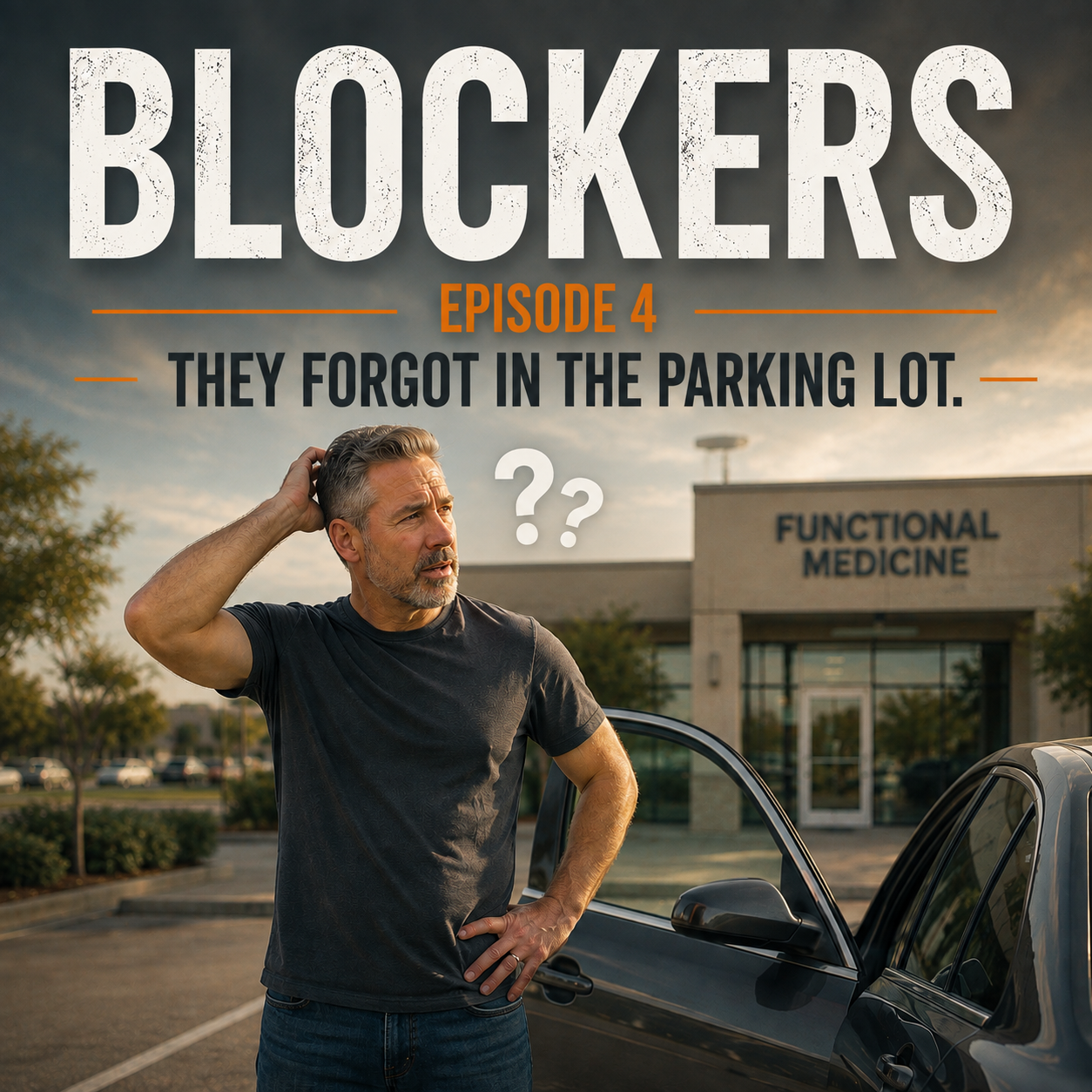
Your patient forgot on the way to their car
BLOCKERS, Episode 4.
You just spent forty-five minutes, or an hour, with a patient. Why?
Because you care about them. And you thought you were being helpful.
Patients should understand what “leaky gut” means, glycemic load, how their hormones work and why they can’t sleep, lose weight.
Or all of the above.
Your patient nodded, thanked you—genuinely—and then went back to their day, confused about what to do when they get home.
And your effort — well-meaning, well-delivered, genuinely expert — may have not only failed to accomplish the thing you were trying to accomplish. There’s a decent chance it was also counterproductive.
Let’s unpack why.
By the time that patient reached their car, most of what you said was gone. Between 40 and 80 percent of the information a healthcare practitioner provides is forgotten immediately.
You probably already knew that.
Here’s the part that’s worse: almost half of what they do remember is wrong.
Both of those numbers come from the same review — Kessels, Patients’ memory for medical information, Journal of the Royal Society of Medicine, 2003.
Patients don’t just leave with less info than you gave them. Some of what they carry out the door has quietly drifted from what you actually said — and neither of you knows which parts.
That’s the counterproductive part. Not that they know less. That they may act on a version of your plan that isn’t quite your plan, and feel confident doing it.
You see this over and over in the questions you get between visits or when patients come back.
What time of day is my injection?
How do take the medicine? Which days? Oh. I thought it was every other day.
When do I see you again?
When do I order labs?
Why am I taking this hormone? I just read something about side effects. Do you have anything I should read about this?
I know you said higher protein, but which foods? Do you have any recipe ideas?
You talked about all of this in detail. You invested valuable time explaining all of this, only to be forgotten.
Here’s the part I want to talk about
You’ve known this for years. So why is it still happening?
Not because you don’t care. You do. And you mean well. And you want to get it done right. You do it because “I told them” is a receipt you can file away. It’s what you were trained to do.
What you’re doing with patients feels right. You’re supposed to lay out the reasons, the evidence, the science and use that to justify the treatment plan, the supplements, the medications. And that takes time.
You did explain it.
The Encounter Note says you counseled the patient on diet, activity and medication adherence. That’s documented. That’s billable. If anyone audits it, you’re covered.
Every part of the system agrees the thing happened.
The only party who disagrees is the patient, standing in the parking lot, already unsure whether they understand everything well enough to tell their spouse. Was it two capsules in the morning or one? Why this course of treatment? Didn’t I read that hormones cause cancer? Aren’t GLP-1’s bad for me?
It’s not the patient’s fault. Not your failure to explain. It’s just that only so much information can fit into a session before you get diminishing returns. And you do it over and over because it generates a receipt for a transfer of knowledge that mostly didn’t occur, so nothing in your day ever flags it as unfinished.
But it costs you more than you think
Walk it forward.
The patient doesn’t follow the plan, because they can’t remember it precisely enough to follow. They might have a prescription or a piece of paper from you.
But do they know the whole plan? The diet, the exercise regimen, the dosage schedule, the date of their next visit, lab draw? Where is the educational material for them to access? How do they reach out to you to ask questions? Because they will have them.
They’ll come back in eight or 12 weeks a little better, or not better, or worse. You adjust. Maybe you re-explain — a second forty-five minutes, spent re-delivering the first forty-five minutes.
They conclude, quietly, that this isn’t working for them. Not that they misremembered. That the protocol failed.
Then they don’t rebook. And you never find out why, because people don’t call to say “I stopped because I was confused.”
Here’s the part that should really get your attention, though.
They also don’t recommend you.
A patient who got a great result tells three people. A patient who quietly decided it didn’t work tells nobody — they just don’t bring you up when a friend asks who to see. That’s not a bad review. It’s an absence, and absences don’t show up anywhere you’d think to look.
Which matters, because referrals are the cheapest patients you will ever get. Every one you don’t earn is another one you have to go buy.
Every one of those is scored in your head as a patient who wasn’t compliant, or wasn’t ready, or wasn’t a good fit.
Some of them were just a person in a parking lot who couldn’t remember all of what you said.
And not only do you not get the number of new patients you should expect for your efforts, you don’t have much time other than figure it out because you’re burning all of these hours that you shouldn’t.
Why nobody fixes it
Here’s the honest reason, and it’s the same trap I described two issues ago.
The fix presents itself as a project.
“Build the patient education” so you don’t have to keep repeating yourself.
“Create a resource library” so you don’t have to keep answering questions and sending resources manually.
“Get a system for follow-up” so you’re not manually tracking and reminding patients about their next appointment, lab draw, medication order, dosage, timing.
Every one of those feels like a project that can’t be finished THIS week, so it gets moved to the version of your calendar where the good ideas go to die.
Someday isle.
Meanwhile the actual gap is much smaller than the project you’ve imagined to close it.
But there’s a second reason it doesn’t get fixed, and it’s the one I think is really holding you in place.
The obvious fix — say less in the room — feels like doing less for the patient.
If somebody told you to cut that forty-five minutes down to fifteen, everything in you would resist it. You’d hear it as: care less. Explain less. Be one of those doctors.
I want to take that apart, and I’m going to do it with a sales story, because it’s the same mistake and I’ve spent years training people out of it.
What I tell my salespeople
When one of my reps gets a good lead on the phone, the instinct is to explain everything. The lead asks a real question — something specific about how our practice management platform handles a workflow — and the sales rep gets excited and delivers eleven minutes of detail.
They think they’re being helpful. They’re being thorough. They know the answer and the answer is good. Yay!
And the call is always worse because of it. Every time.
Why?
Because the person on the other end didn’t want eleven minutes. They wanted to know they’d asked a reasonable question and that there was a real answer. Everything said after that is water off a duck.
So what I train my sales reps to do is this:
Answer briefly — Thirty seconds of a real answer that we have the function and it works. Then say: that’s a really good question, and it’s exactly the kind of thing we should unpack properly on a longer demo. When can I get you on the calendar?
The question becomes a pivot opportunity. And the answer is not a dodge — it’s actually a improvement. You’ve just told them their question deserves more room than this call can give it.
And then the line that matters most: let me get you back to your busy day. We’ve got this.
That sentence does more for a deal than the eleven minutes ever did. It says I respect your time, I’m not going to hold you hostage, and I’m confident enough in what I’ve got that I don’t need to dump all of it on you right now. And it quietly acknowledges what both parties know but don’t say out loud—OK, but I’m not going to remember all of this. That’s why customers so often say:
“Can you send me some of those details after our call?”
Nobody has ever gotten off a call annoyed that it was short and clear.
Your visit with the patient is like that call. It shouldn’t be a one hour demo.
Here’s the switch, and I think it’s exact.
The forty-five minutes isn’t where the information you give your patients should live. It’s where trust gets built and direction gets set. Those are the two things that can only happen in the room, with you, face to face.
Detail should be in the follow up. Detail is terrible in a meeting room with someone that sees you as the expert.
A detailed meeting narrative arrives once. It can’t be paused. It can’t be re-read. It’s delivered to someone who is anxious, possibly frightened, possibly still processing the word you said four minutes ago. There is no replay button on your voice.
That’s not a failure of your explaining. It’s a container problem. You’re pouring the most complex part of the visit into the least durable format available to you.
Detail needs time to open up. Coffee has to bloom. Wine has to breathe. Nobody blames the bean.
Your patient needs to sit with those details at nine o’clock at night, on their couch, with a glass of water, when the stress of being in a doctor’s office has worn off and they can read a sentence twice and discuss it with their significant other.
That isn’t less care. That’s putting the care where it survives.
You already have the structure. Just stop earlier.
But you do already have a structure, and it’s the one you were trained on.
Subjective. Objective. Assessment. Plan. I’ll botch this a little to make my point but:
(S) Listen and acknowledge what they told you. (O) Tell them what you’re seeing. (A) Tell them what you think is going on in the data you have available. (P) Then give them the plan.
That’s the whole visit, and you already do it.
Here’s the only change I’d make:
give them the plan as headlines, and stop there.
Not an appendix. Not a binder. Not a 30 minute monologue.
The dosing schedule, the timing, why this protocol and not the other one, what to watch for in week three, the interaction they read about online — that’s the appendix. And the appendix was never a room document. It arrives once, it can’t be re-read, and it lands on someone whose adrenaline is up.
Headlines in the room. Appendix in the follow-up.
The last sentence
There’s one more thing they need, and it’s the sentence that makes a shorter visit feel generous instead of rushed.
They need to know the rest is coming.
Not vaguely. Specifically. Everything we just talked about — the full plan, the instructions, the reasons behind it — is coming to you over the next few days and weeks, in order. You don’t have to hold any of this in your head right now. It’ll be there when you need it. I have an app for that. It’s all in your portal account. You’ll get it dripped out or on demand in your account, etc.
Say that, and the whole dynamic of the visit changes.
The patient stops trying to memorize. They stop nodding while quietly panicking that they’ve already lost the thread. They can be present with you, because they know there’s a net. It’s the equivalent of what your AI scribe does for you.
And then you get to say the medical version of the line I teach my reps:
Don’t worry about remembering everything. Let me get you back to your day. The rest of this is handled.
That patient leaves confident. Not because they retained more — they didn’t, and they never will — but because they know they weren’t supposed to.
Just start with one thing
Pick one condition you’re talking about for too long. Not all of them. The one you explain most often — the one where you can hear yourself giving the same speech every week. For an hour.
Write the long explanation once.
Not the full course.
Not the resource library.
The thing you say out loud after the plan, every single time, to every patient with that diagnosis. The dosing. The timing. The reason. The two things that usually go wrong in the first month.
Write it the way you’d say it, not the way a handout says it.
Then add one line at the end: what’s coming next, and when.
That’s it. That’s the whole thing.
Promise to send it after the meeting. Then send it to that patient after the visit in their app where they can read it, all at once, or in pieces. Then send the same thing to the next patient who has that condition. And the patient after that.
Twenty minutes, once, and it works forever.
Don’t think of it as building patient education. That’s a blocker. Just write down the speech you already give, so it survives the parking lot.
If it helps, dictate it. Talk it into your phone the way you’d say it to a patient, and let AI clean it up. Or dictate it into AI.
What to do today
Pick the one condition you explain most often. The one you could do in your sleep.
Write the monologue. Everything you say after the plan — dosing, timing, the reason, what usually goes wrong. However long it needs to be. This is the part that was never going to survive the room anyway.
Add the line that tells them what’s coming. This is the one that lets you shorten the visit without it feeling like a shortcut.
Send it to the next patient who walks out with that diagnosis. Text, email, portal, printout. The channel doesn’t matter today.
Then reuse it. The reuse is where the whole return lives. The first send helps one patient. The hundredth changes your practice.
Do not start a library. If you catch yourself opening a tab to compare patient education platforms, that’s a project starting. Close it. One condition. One appendix. One promise.
And where I come in
Nothing above needs me. A text message counts. So does a note in the portal you already have.
But you’ll hit the next blocker fast, and it’s a real one: doing this by hand for every patient, every condition, at the right interval, forever, is a job. It works for one condition and falls apart at twelve.
What you actually want is for the promise you made in the room to keep itself. The appendix goes out that afternoon. The deeper explanation arrives on day three, when they’re ready for it. The check-in lands on day nine, when the enthusiasm has worn off and the questions have started. None of it requires you to remember anything.
That’s the part I’m actually useful for. Content libraries when you don’t want to write it yourself, a way to attach the right material to the right patient automatically, and a record of what they were sent and whether they opened it.
But I’d rather you write the appendix first. Write that 20 minute monologue once, now, for that one condition. Because if you can’t say what the patient needs to know, no platform on earth will figure it out for you — and if you can, you’ve already done the hard part.
They’re going to forget it in the parking lot. That’s not going to change.
What can change is whether it mattered.
Email me and say blocked, and I’ll help you find your first thing.
John Cummings
Founder, BodySite.com
Catch up on the series: Episode 1 — Stop looking at the car · Episode 2 — What should I do first? · Episode 3 — Just start with breakfast